
The importance of spinal rotation in Pilates
Joseph Pilates said “If your spine is inflexibly stiff at 30, you are old; if it is completely flexible at 60, you are young”.
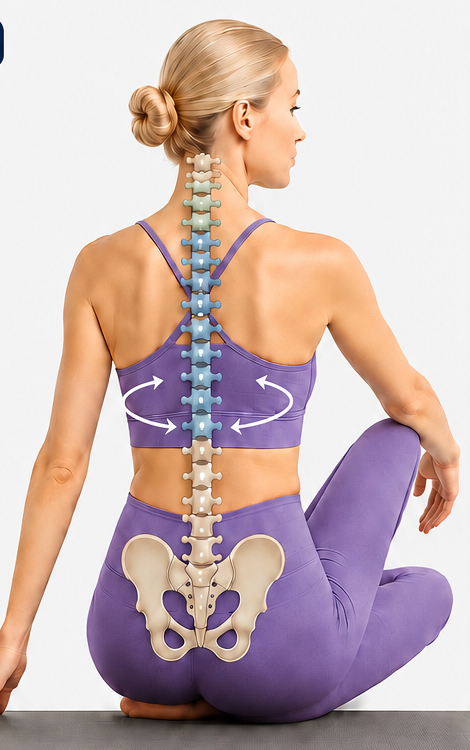
Each vertebra of the spine contributes a small amount of rotation. In a healthy spine, the vertebrae of the neck provide the most rotation (50-80°), the vertebrae of the thoracic (mid) and lumbar (lower) spine combined provide 30-45° of rotation Most of this comes from the thoracic spine, with very limited rotation in the lumbar.
Spinal rotation is one of the first movements to diminish with old age. In addition, many people become stiff in the mid-back from prolonged sitting. This ca
n lead to compensatory twisting through the neck or lower back. So, maintaining good rotation is vital to the health of the spine and mobility as we age.
The role of Pilates
Pilates uses controlled rotational exercises, working the vertebrae bone by bone, supported by core and stabilising muscles and controlled breathing to maintain mobility and suppleness.
The benefits
Improves thoracic mobility & eases stiffness and pain
As healthy rotation of the thoracic spine can be impeded by more sedentary lives and aging, Pilates rotation exercises help restore movement where it is intended, thus avoiding compensatory movement and reducing stiffness and associated discomfort or pain.
Trains the oblique and deep core muscles
Pilates’ rotational exercises recruit the internal and external oblique muscles (side abdominals), transverse abdominis, multifidus, and pelvic floor to enable controlled rotation with core stability. In turn, correct muscle recruitment and strength supports functional movement and day to day activities.
Supports posture
Good rotational mobility in the upper back helps the rib cage move more freely. This can make it easier to maintain an upright posture without excessive tension in the shoulders or neck.
Enhances functional movement
A lot of daily activities require good coordinated spinal rotation. For example, reaching behind you, getting in and out of a car, enjoying many sports (think golf, tennis), even walking which involves rotation and ribcage mobility with each stride. Pilates teaches the pelvis, rib cage, shoulders and head to rotate in an organized sequence.
Balances the body
Pilates works both rotational directions equally. This helps to identify and with consistent practice, reduce asymmetries.
Integrates breath with movement
By using a controlled breathing pattern with rotational exercise, Pilates can improve rib cage mobility and encourage deeper activation of the abdominal wall.
NB: Spinal rotation in Pilates focuses on length and control and should never involve aggressive twisting. It may not be appropriate for everyone in the same way. Professional guidance should be sought and exercises modified if you have:
an acute disc injury or sciatica,
recent spinal surgery,
osteoporosis,
significant spinal instability,
unexplained back pain.
In short
Properly performed rotational work can help keep the thoracic spine mobile, strengthen supporting core muscles, improve movement patterns and efficiency and so reduce compensatory strain elsewhere in the body.

Pilates supports spinal rotation combining mobility, stability, strength, posture, breathing, and functional movement, reducing stiffness, pain and supporting daily life and activities.

Comments